Customer advocacy campaigns turn your most satisfied customers into an active, credible growth channel — through testimonials, referrals, reviews, and organic word of mouth. This guide covers what customer advocacy campaigns look like in practice, the most effective formats, and a step-by-step process for building a program that consistently generates real results.
Every business has customers who genuinely love what they do — the question is whether that enthusiasm is being captured and put to work, or simply left to happen on its own. Customer advocacy campaigns are how businesses intentionally turn that organic goodwill into a structured, repeatable marketing asset. Rather than hoping happy customers mention the brand occasionally, customer advocacy campaigns give those customers an easy, rewarding way to share their experience at scale.
In this guide, we’ll break down exactly what customer advocacy campaigns involve, the most common formats used across industries, and how to build a program from scratch. For foundational context, our guide on what makes a strong customer advocate is a useful starting point before diving into campaign structure specifically.
What Are Customer Advocacy Campaigns?
Customer advocacy campaigns are structured marketing initiatives designed to encourage, capture, and amplify positive customer experiences — turning individual satisfaction into visible, shareable proof that influences other potential buyers. This can take many forms: a customer sharing a testimonial video, participating in a case study, referring a friend, leaving a detailed review, or simply posting organically on social media because a brand made that easy and rewarding to do.
What separates customer advocacy campaigns from generic customer satisfaction efforts is intentionality. A satisfied customer might mention a brand once in passing; a well-designed advocacy campaign gives that same customer a clear, easy path to share their experience in a way that reaches a wider audience and drives measurable business results.
Why Customer Advocacy Campaigns Work
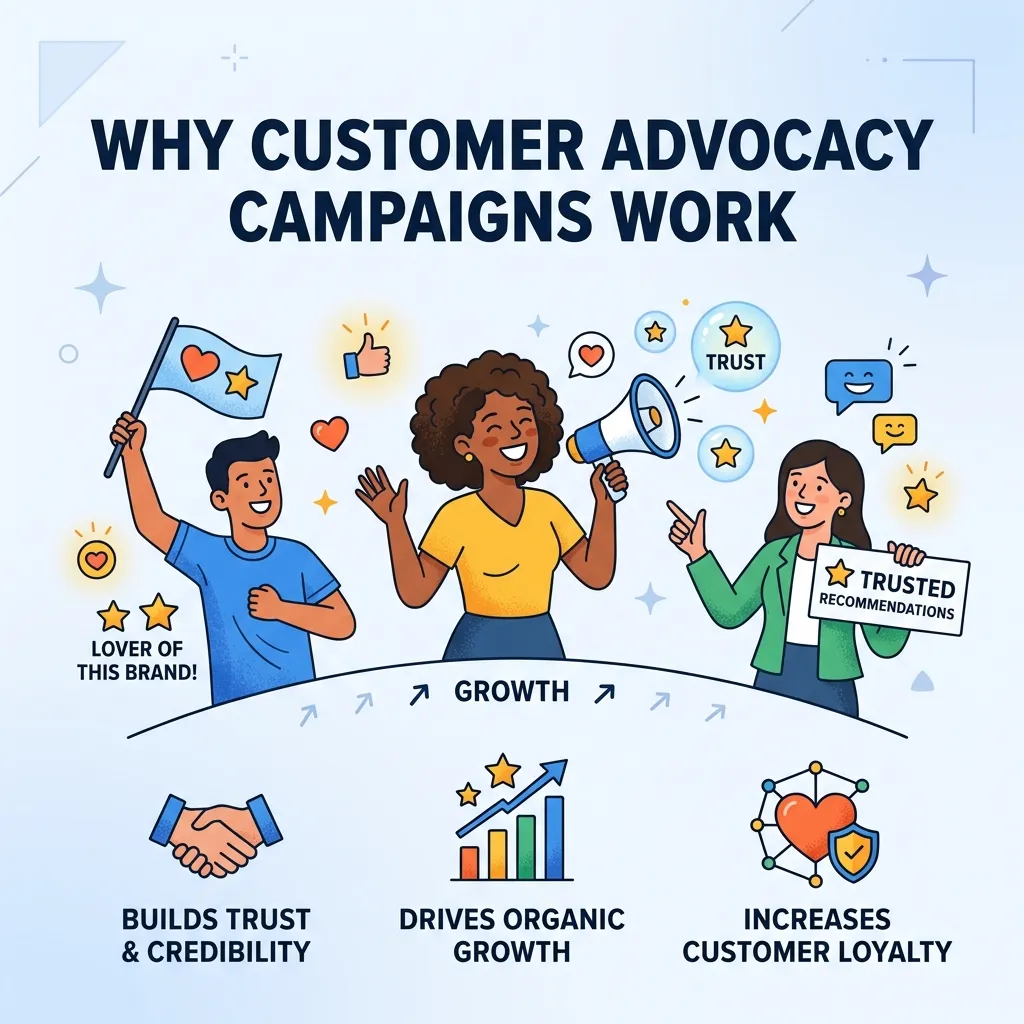
Modern buyers are skeptical of traditional advertising and increasingly rely on peer opinions before making a decision. Customer advocacy campaigns work because they replace brand-authored claims with third-party validation — and that validation carries far more weight with prospective customers. A single authentic customer story often outperforms a polished ad, simply because audiences trust people who look and sound like themselves more than they trust a company talking about its own product.
Beyond trust, customer advocacy campaigns are also remarkably cost-efficient compared to many paid acquisition channels. Once a program is established, the content and referrals it generates continue delivering value with a fraction of the ongoing spend required for paid advertising, making advocacy one of the highest long-term ROI channels available to most businesses.
Common Types of Customer Advocacy Campaigns
There’s no single format for customer advocacy campaigns — the right approach depends on the business, the customer relationship, and the specific goal.
Referral Campaigns
One of the most direct forms of customer advocacy campaigns, referral programs incentivize existing customers to introduce new ones, often through a discount, credit, or reward for both parties. Our guide on building a customer referral program walks through the mechanics of designing incentives that motivate sharing without feeling transactional.
Testimonial and Case Study Campaigns
These customer advocacy campaigns capture detailed stories from satisfied customers — often including specific, measurable results — and turn them into video, written, or social content used across the buyer journey. Our resource on customer stories and testimonials covers how to structure these stories for maximum credibility and impact.
Review Generation Campaigns
Encouraging customers to leave reviews on relevant platforms is one of the simplest customer advocacy campaigns to run, yet it remains one of the most impactful, since public reviews directly influence purchase decisions for prospective buyers doing their own research.
Brand Ambassador Programs
More formal than a simple referral or review request, ambassador-based customer advocacy campaigns identify especially enthusiastic customers and give them an ongoing relationship with the brand — early access to products, exclusive content, or recognition in exchange for consistent, authentic promotion.
User-Generated Content Campaigns
These customer advocacy campaigns invite customers to create and share their own content — photos, videos, or posts — often organized around a specific hashtag or challenge. This format works especially well on visual platforms like Instagram and TikTok, where authentic, unpolished content often performs better than brand-produced material.
Employee Advocacy Campaigns
While most customer advocacy campaigns focus on external customers, employee advocacy extends the same principle internally, encouraging staff to share company content and achievements through their own networks, which often carries additional credibility due to their firsthand expertise.
How to Build a Customer Advocacy Campaign Step by Step
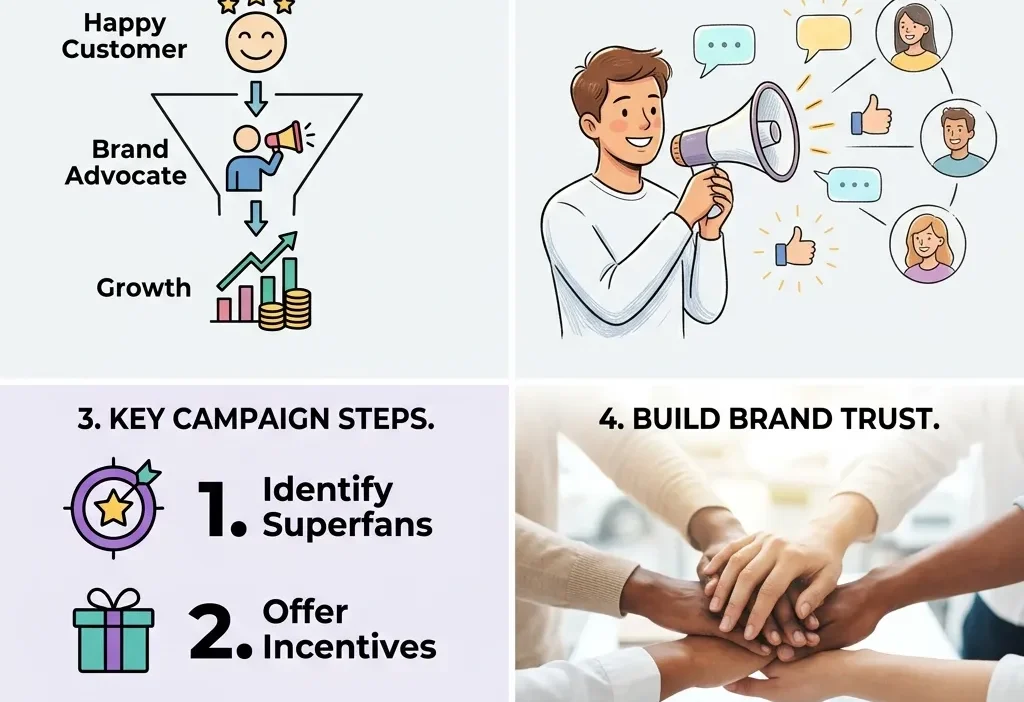
Launching effective customer advocacy campaigns doesn’t have to be complicated if you follow a clear process:
- Identify your best candidates. Look at customer satisfaction scores, repeat purchase behavior, and organic mentions to find customers already showing strong enthusiasm.
- Choose the right format. Match the campaign type to your business model — referral programs for consumer products, case studies for B2B, user-generated content for visually driven brands.
- Make participation easy. Reduce friction wherever possible, whether that’s a simple referral link, a short review request, or a straightforward video call for a testimonial.
- Offer meaningful incentives. Rewards don’t always need to be financial — recognition, early access, or exclusive community membership can motivate participation just as effectively for many customer advocacy campaigns.
- Amplify the content. Once collected, distribute testimonials, reviews, and user content across your website, social channels, sales materials, and email campaigns rather than letting it sit unused.
- Measure and refine. Track participation rates, content quality, and downstream business impact, adjusting incentives or formats based on what actually drives results.
Real-World Examples of Effective Customer Advocacy Campaigns
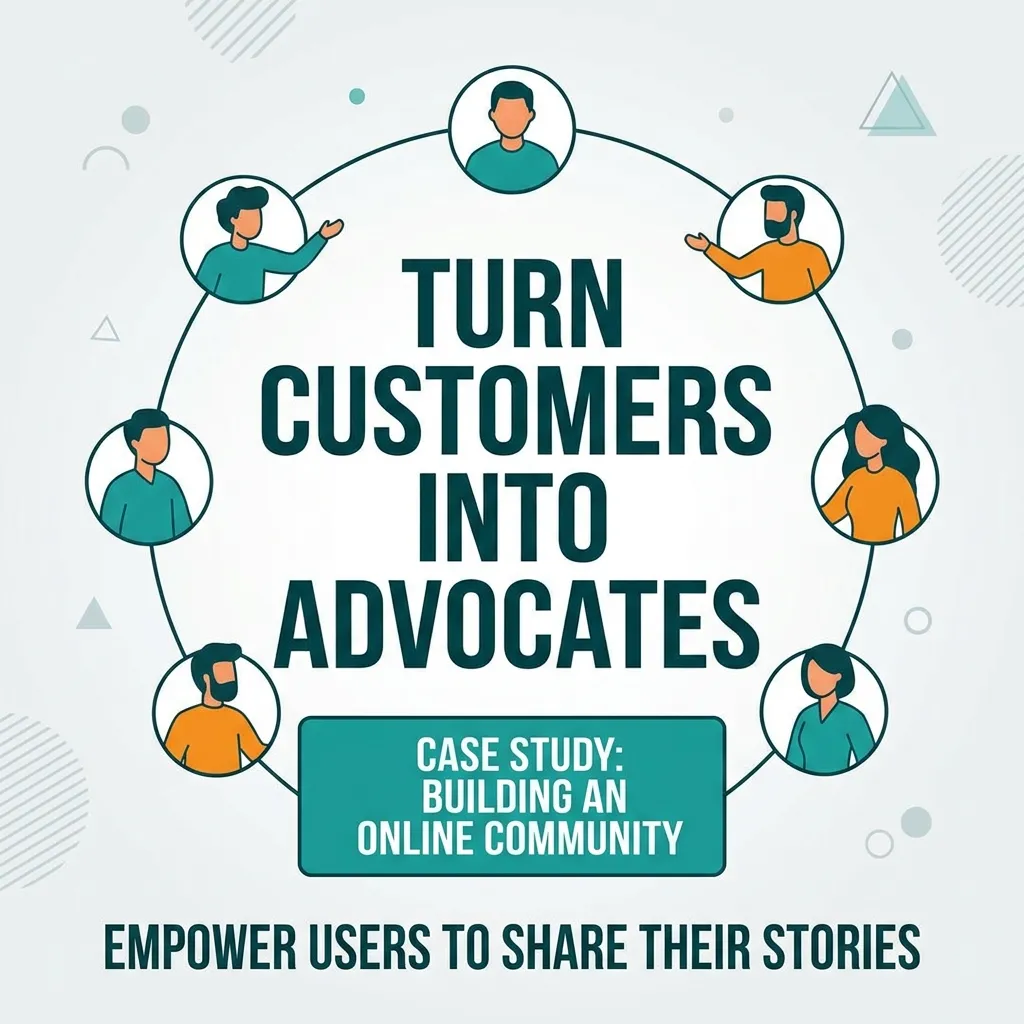
Some of the most memorable customer advocacy campaigns combine several formats at once. A software company might pair a formal case study program with an informal user community where customers naturally share tips and success stories, while also running a lightweight referral incentive for existing accounts. A consumer brand might run a hashtag-based user-generated content campaign that doubles as a review-generation effort, since customers posting photos often also leave reviews as part of participating.
Our collection of customer advocacy examples offers a broader look at how different companies structure these campaigns based on their specific audience and product type.
Measuring the Success of Customer Advocacy Campaigns
Because customer advocacy campaigns often blend qualitative content with measurable business outcomes, tracking success requires looking at multiple layers:
- Participation rate — the percentage of eligible customers who engage with the campaign
- Content volume and quality — the number and strength of testimonials, reviews, or user posts generated
- Referral conversion rate — how many referred leads actually become paying customers
- Influence on sales cycles — whether prospects exposed to advocacy content convert faster or at higher rates
- Advocate retention — whether customers who participate in advocacy activities also show higher loyalty and lifetime value
Our detailed guide on measuring brand advocacy metrics and KPIs provides a fuller framework for tracking these outcomes over time, since a strong customer advocacy campaign should ultimately tie back to measurable pipeline and retention impact rather than vanity metrics alone.
Customer Advocacy Campaigns and Customer Lifetime Value
There’s a natural relationship between customer advocacy campaigns and long-term customer value — customers who actively advocate for a brand tend to be more engaged and more loyal than average, which often translates into higher retention and spend over time. Understanding customer lifetime value can help prioritize which customer segments are worth investing the most advocacy-building effort in, since not every customer relationship carries the same long-term potential.
Pairing advocacy efforts with a strong loyalty program often creates a reinforcing cycle: loyal customers are more likely to advocate, and advocacy activities in turn deepen loyalty, creating a compounding effect that’s difficult to replicate through paid acquisition alone.
Common Mistakes in Customer Advocacy Campaigns
Even well-intentioned customer advocacy campaigns can underperform due to avoidable mistakes:
- Asking too early, before a customer has had enough time to experience real value from the product or service
- Making participation difficult, with clunky forms, unclear instructions, or too many steps required to share a story or refer a friend
- Relying only on financial incentives, missing opportunities to motivate advocacy through recognition and genuine relationship-building
- Collecting content but never using it, leaving valuable testimonials and reviews buried instead of actively distributed across marketing channels
- Ignoring measurement, running advocacy campaigns without tracking whether they actually influence pipeline, retention, or revenue
Customer Advocacy Campaigns Across Different Business Types
The specific shape of an effective customer advocacy campaign varies depending on business model. E-commerce brands often see strong results from review generation and user-generated content campaigns tied to visual platforms, since product photos and short videos translate directly into social proof. B2B companies typically rely more heavily on detailed case studies and reference customers willing to speak directly with prospects during the sales process, since these purchases involve longer evaluation periods and higher stakes. Subscription and membership businesses often blend referral programs with community-driven advocacy, since ongoing engagement naturally creates more touchpoints for customers to share their experience over time.
The Role of AI in Modern Customer Advocacy Campaigns
AI tools are increasingly used to identify potential advocates by analyzing engagement data, satisfaction scores, and social mentions at scale — surfacing customers most likely to participate before a team manually reviews every account. AI is also being used to help draft outreach messages, summarize testimonial content, and even generate short video clips from longer customer interviews, making it easier to run customer advocacy campaigns efficiently even with limited internal resources.
Building a Long-Term Customer Advocacy Program
The most successful customer advocacy campaigns aren’t treated as isolated, one-time pushes — they’re built into an ongoing program with a consistent process for identifying advocates, capturing their stories, and distributing that content across marketing and sales. Businesses that revisit and refresh their approach regularly, testing new formats and incentives, tend to see advocacy contribute steadily growing value over time rather than a short-lived spike followed by declining participation.
Customer Advocacy Campaigns vs. Paid Advertising
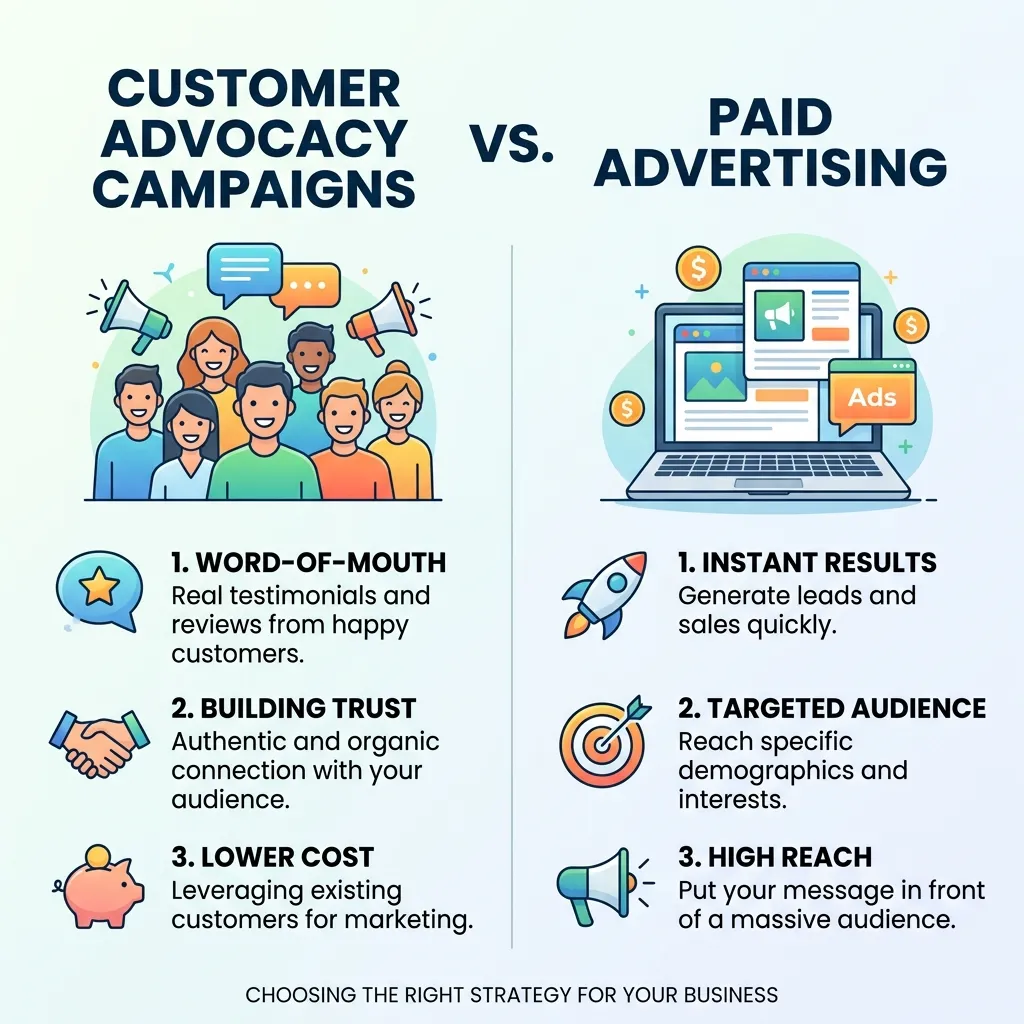
It’s worth understanding how customer advocacy campaigns compare to traditional paid advertising, since the two channels behave very differently over time. Paid ads deliver immediate, controllable reach, but that reach disappears the moment spend stops. Customer advocacy campaigns, by contrast, tend to build compounding value — a strong testimonial or case study can continue influencing buyers for months or years after it was first published, and a well-designed referral program keeps generating new customers long after the initial setup effort.
This doesn’t mean advocacy should replace paid channels entirely; the two typically work best together. Advertising can drive initial awareness and acquisition, while customer advocacy campaigns strengthen conversion rates and retention once those customers are already in the funnel. Our external comparison of word of mouth versus paid ads for brand growth explores this relationship in more depth, including how businesses can balance investment between the two approaches based on their specific growth stage and budget constraints.
Key Takeaways on Customer Advocacy Campaigns
Before wrapping up, here’s a quick recap of the essentials: successful customer advocacy campaigns start by identifying genuinely satisfied customers, match the format to the business model, make participation as easy as possible, and distribute the resulting content actively rather than letting it sit unused. Measuring real business outcomes — not just participation counts — is what separates customer advocacy campaigns that meaningfully contribute to growth from those that generate content without ever translating into pipeline or retention gains.
Conclusion
Customer advocacy campaigns turn genuine customer satisfaction into one of the most credible and cost-effective growth channels available to any business. By choosing the right formats, making participation easy, distributing the resulting content widely, and measuring real business impact rather than vanity metrics, companies can build customer advocacy campaigns that compound in value over time. In a marketing landscape where trust is increasingly hard to earn through advertising alone, a well-run advocacy program remains one of the most reliable ways to let happy customers do some of the most persuasive marketing work for you.
Frequently Asked Questions (FAQs)
1. What are customer advocacy campaigns?
Customer advocacy campaigns are structured initiatives that encourage satisfied customers to share testimonials, referrals, reviews, or other content that promotes a brand to potential new customers.
2. How are customer advocacy campaigns different from referral programs?
Referral programs are one specific type of customer advocacy campaign; advocacy more broadly also includes testimonials, reviews, user-generated content, and ambassador programs.
3. Why are customer advocacy campaigns effective?
They work because third-party validation from real customers is generally more trusted by prospective buyers than brand-authored advertising claims.
4. How do I find the right customers for advocacy campaigns?
Look at customer satisfaction scores, repeat purchase behavior, and existing organic mentions to identify customers already showing strong enthusiasm for the brand.
5. Do customer advocacy campaigns require financial incentives?
Not necessarily. Recognition, early access, and community involvement can motivate participation just as effectively as discounts or monetary rewards for many customers.
6. How do you measure the success of customer advocacy campaigns?
Key metrics include participation rate, content volume and quality, referral conversion rate, and the campaign’s measurable influence on sales cycles and retention.
7. What industries benefit most from customer advocacy campaigns?
Nearly every industry can benefit, though the format varies — e-commerce often favors reviews and user-generated content, while B2B companies lean more on detailed case studies and reference customers.
8. How soon after a purchase should advocacy be requested?
Timing matters — asking too early, before a customer has experienced real value, often results in weaker or less enthusiastic participation.
9. Can customer advocacy campaigns improve customer retention?
Yes, customers who actively participate in advocacy activities often show stronger loyalty and higher lifetime value than customers who don’t engage at all.
10. What’s the biggest mistake brands make with customer advocacy campaigns?
Collecting testimonials and reviews but failing to actively distribute that content across marketing and sales channels is one of the most common and costly mistakes.
11. How is AI changing customer advocacy campaigns?
AI is increasingly used to identify likely advocates from engagement data and to help summarize or produce content from testimonials and interviews more efficiently.
12. Should customer advocacy campaigns be a one-time effort or ongoing?
Ongoing programs consistently outperform one-time pushes, since a repeatable process for identifying, capturing, and distributing advocacy content compounds in value over time.