It is the practice of turning satisfied customers into active promoters who refer, review, and defend your brand without being paid to do so. Building this requires more than good products — it demands intentional trust-building, structured programs, the right technology, and consistent recognition of the people who champion you. This guide walks through exactly how to build customer advocacy from the ground up, covering the frameworks, tools, real-world examples, and common mistakes that determine whether a program actually drives growth or quietly fails.
Every business wants happy customers, but very few businesses know how to turn that happiness into a repeatable growth engine. That is precisely what this discipline does. When you build it the right way, your customers become an extension of your marketing and sales team — recommending you at dinner parties, defending you in comment sections, and writing reviews before you even ask.
The challenge is that this does not happen by accident. It requires a deliberate strategy, the right internal culture, and systems that make it easy for customers to speak up on your behalf. In this guide, we will break down what it actually means, why it matters more today than ever, and a complete framework you can follow to build it inside your own organization.
What Is Customer Advocacy?

At its core, this is a business philosophy where every decision — from product design to customer support — is made with the customer’s best interest in mind. As Wikipedia describes it, customer advocacy is a specialized form of customer service in which companies focus on what is best for the customer, reflecting a shift in company culture supported by customer-focused service and marketing techniques.
In practical terms, it shows up in two forms:
- External advocates — real customers who voluntarily promote your brand through referrals, reviews, testimonials, and word-of-mouth recommendations.
- Internal advocates — employees whose job is to represent the voice of the customer inside the company, pushing for changes that improve the overall experience.
If you want a deeper breakdown of who these advocates are and how they behave, our complete guide to customer advocates covers the topic in detail.
Building this, then, is not a single marketing tactic. It is an ongoing commitment to earning trust so thoroughly that customers choose to speak up for you unprompted.
Why Customer Advocacy Matters More Than Ever
Trust in traditional advertising has declined steadily, while trust in peer recommendations has only grown. People are far more likely to buy something recommended by a friend than something they saw in an ad. This is exactly why this discipline has become one of the highest-leverage growth channels available to modern businesses.
There is also a retention argument for it. Businesses that focus on keeping and delighting existing customers see outsized returns: as Harvard Business Review reports, increasing customer retention rates by just 5% can increase profits by 25% to 95%. Since retained, delighted customers are the exact pool that advocacy programs draw from, the connection between retention and advocacy is direct.
When you invest here, you are effectively investing in:
- Lower customer acquisition costs, since advocates bring in referrals organically.
- Higher-quality leads, because people trust recommendations from people they know.
- Stronger customer retention, since these programs deepen emotional connection to the brand.
- Better product feedback, since advocates are often your most engaged users.
Customer Advocacy vs. Brand Advocacy
People frequently use “customer advocacy” and “brand advocacy” interchangeably, but there is a meaningful distinction. The former term is specifically about customers who have used your product and speak from direct experience. Brand advocacy is broader and can include employees, partners, influencers, or fans who support your brand even without being paying customers.
If you’re building a program and need clarity on which approach fits your goals, this comparison explains the differences and where each strategy works best. For most companies, the most durable growth comes from anchoring your strategy in real customer experience first, then expanding into broader brand advocacy over time.
The Complete Framework: How to Build Customer Advocacy in 8 Steps
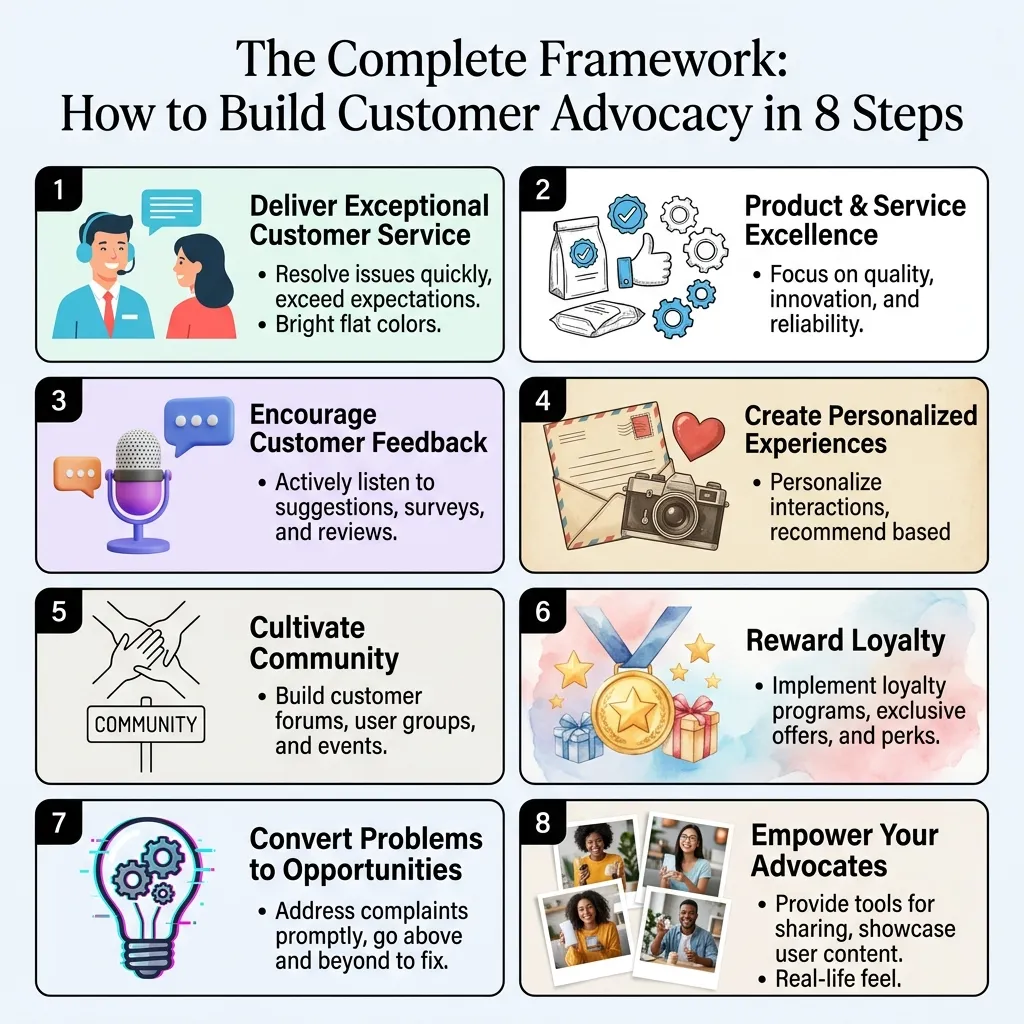
Building this is a process, not a one-time campaign. Below is a step-by-step framework that works whether you are a small startup or an established enterprise.
Step 1: Deliver a Product Experience Worth Talking About
No advocacy program can compensate for a mediocre product or poor service. Before anything else, make sure your core experience consistently exceeds expectations. Map out your entire customer journey and remove friction at every touchpoint — onboarding, support, billing, and everyday usage. Advocacy is a downstream result of a genuinely great experience, not a marketing trick layered on top of a weak one.
Step 2: Identify Your Strongest Potential Advocates
Not every satisfied customer will become an advocate, and that’s fine. Your job is to identify the ones who are already showing advocacy behaviors — leaving positive reviews, mentioning you on social media, referring friends, or engaging heavily with your product. Our guide on how to find brand advocates in your customer base outlines practical ways to surface these customers using surveys, usage data, and support interactions.
Step 3: Build Genuine Trust Before You Ask for Anything
This cannot be manufactured through pressure or incentives alone. It has to be earned. Be transparent about pricing, admit mistakes quickly, and follow through on promises. Trust is the foundation that everything else in an advocacy program is built on. For a deeper look at the trust-building process itself, read our guide on how to build brand trust that drives loyalty.
Step 4: Design a Structured Customer Advocacy Program
Once you have identified potential advocates and built trust, you need a formal structure to channel that goodwill. A structured program typically includes clear entry criteria, defined actions (reviews, referrals, case studies, social shares), and a system for tracking participation. Our complete guide to building a customer advocacy program walks through how to design one from scratch.
Step 5: Choose the Right Customer Advocacy Platform
Trying to manage it manually through spreadsheets does not scale. A dedicated platform automates advocate identification, tracks referral and review activity, manages rewards, and gives you visibility into program ROI. If you’re evaluating options, our breakdown of what to look for in a customer advocacy platform can help you choose the right one for your team’s size and goals.
Step 6: Collect and Amplify Customer Stories
Testimonials and case studies are some of the most persuasive assets a business can own, and they are a direct output of a healthy advocacy effort. Make it effortless for advocates to share their experience by providing simple submission forms, short video prompts, or guided interviews. Our guide to customer stories and testimonials covers how to collect and publish these assets effectively.
Step 7: Reward Advocates Meaningfully
Recognition does not always need to be financial. Public shout-outs, early access to new features, exclusive community access, or simple handwritten thank-you notes often mean more to advocates than discount codes. The goal of any reward here is to reinforce the behavior without making the relationship feel transactional — advocacy should still feel voluntary and genuine.
Step 8: Track Metrics and Optimize Continuously
You cannot improve what you do not measure. Track referral volume, review velocity, advocate participation rate, and the downstream revenue generated by advocate-driven leads. A widely used proxy metric here is the Net Promoter Score, a customer loyalty measurement methodology developed by Fred Reichheld, which many teams use as an early indicator of advocacy potential. For a full breakdown of which numbers matter, see our guide on how to measure brand advocacy metrics and KPIs.
Real Customer Advocacy Strategy Examples
Seeing this in action makes the framework above much easier to apply. Companies that succeed at this typically combine several tactics at once: gated referral incentives, public customer spotlight campaigns, private advocate communities, and co-marketing opportunities like joint webinars or case studies.
For a broader set of real-world examples across industries, we’ve rounded up several proven approaches that show how different types of businesses activate their happiest customers, along with more tactical, campaign-level playbooks you can adapt for your own team.
Common Mistakes That Kill Customer Advocacy Programs
Even well-intentioned efforts fail for predictable reasons. Watch out for these pitfalls:
- Asking too early. Requesting a referral or testimonial before a customer has experienced real value undermines the entire premise of advocacy.
- Over-incentivizing. When rewards become the only reason someone advocates, the recommendations feel less authentic and convert worse.
- No feedback loop. If internal advocacy — employees raising customer concerns — is ignored, external advocacy will eventually erode too.
- Treating it as a one-off campaign. This is a continuous program, not a quarterly push.
- Ignoring segmentation. Not all advocates want to advocate the same way; some prefer writing reviews, others prefer referrals or social shares.
Avoiding these mistakes is often the difference between an initiative that fizzles out and one that compounds year over year.
Scaling Advocacy with Campaigns and Technology

Once the foundational program is in place, scaling it means running structured, repeatable campaigns rather than one-off asks. This might include seasonal referral pushes, milestone-based recognition campaigns, or always-on review requests triggered automatically after key product moments.
It also helps to have an overarching strategy document that ties every tactic back to business goals, so the program keeps growing in a way that’s tied to real outcomes rather than random one-off pushes.
Conclusion
Learning how to build customer advocacy is ultimately about earning the kind of trust and satisfaction that makes customers want to talk about you — and then making it easy for them to do so. Start with a genuinely great customer experience, identify the customers already showing advocacy behaviors, build a structured program supported by the right platform, and measure everything so you can keep improving. This is not a short-term marketing hack; it is a long-term growth strategy that compounds as your happiest customers keep bringing in the next generation of happy customers. Done consistently, customer advocacy becomes one of the most cost-effective and durable growth channels any business can build.
Frequently Asked Questions
1. What is customer advocacy in simple terms?
It is when a business focuses on genuinely serving customer interests, and in return, satisfied customers voluntarily promote the brand through referrals, reviews, and recommendations.
2. How is customer advocacy different from customer loyalty?
Customer loyalty describes a customer who keeps buying from you, while customer advocacy describes a customer who actively promotes you to others. Loyalty is passive; advocacy is active and outward-facing.
3. How long does it take to build a customer advocacy program?
Most companies need three to six months to design, launch, and see early traction from a structured program, though meaningful scale usually takes a year or more of consistent effort.
4. Do I need a dedicated platform to build customer advocacy?
Not at first. Early-stage programs can run on spreadsheets and manual outreach, but a dedicated platform becomes essential once you’re managing more than a handful of advocates.
5. What industries benefit most from customer advocacy?
It works across nearly every industry, but it is especially powerful in SaaS, B2B services, healthcare, and consumer products, where trust and peer validation heavily influence buying decisions.
6. How do I find my first customer advocates?
Look at your most engaged users, your highest Net Promoter Score responders, and customers who have already left unprompted positive reviews or referrals.
7. Should customer advocacy programs offer financial rewards?
Financial rewards can help, but they should not be the sole motivator. Combining recognition, exclusive access, and modest incentives tends to produce more authentic, sustained advocacy.
8. What metrics matter most for customer advocacy?
Key metrics include referral volume, review velocity, advocate participation rate, Net Promoter Score, and the revenue attributable to advocate-driven leads.
9. Can employees be part of a customer advocacy strategy?
Yes. Internal advocacy, where employees represent the customer’s voice inside the company, often strengthens the external version by improving the underlying experience customers are promoting.
10. Is customer advocacy the same as affiliate marketing?
No. Affiliate marketing is typically transactional and commission-based, while customer advocacy is rooted in genuine satisfaction, even though both can involve referral incentives.
11. How do small businesses build customer advocacy without a big budget?
Small businesses can do this by personally thanking top customers, asking for reviews at the right moment, sharing customer stories on social media, and creating simple referral incentives — none of which require expensive tools.
12. What is the biggest mistake companies make with customer advocacy?
The most common mistake is asking too early or too often, before genuine trust and satisfaction have been established, which makes the request feel transactional rather than earned.