Customer Advocacy Marketing turns satisfied customers into active supporters who share their experiences, recommend products, provide testimonials, and generate referrals. Instead of depending entirely on traditional advertising, businesses can use authentic customer experiences to build trust, increase social proof, improve retention, and support customer acquisition. This guide covers customer advocacy strategy, programs, campaigns, examples, platforms, best practices, and practical steps for building an effective advocacy program.
What Is Customer Advocacy Marketing?
Definition of Customer Advocacy Marketing
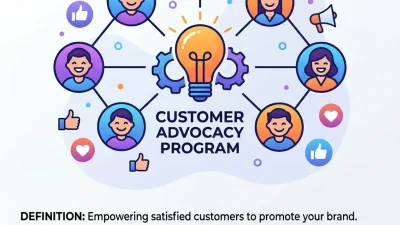
Customer Advocacy Marketing is a strategy that encourages satisfied customers to voluntarily support, recommend, or promote a company’s products or services based on their genuine experiences.
Customer advocates may participate by:
- Writing reviews and testimonials
- Referring friends or colleagues
- Sharing customer stories
- Creating user-generated content
- Participating in case studies
- Sharing content on social media
- Joining customer communities
- Speaking at events or webinars
- Providing product feedback
- Recommending a product to potential buyers
The main idea is simple: instead of a company telling prospects how good its product is, real customers demonstrate the value through their own experiences.
How Customer Advocacy Marketing Works
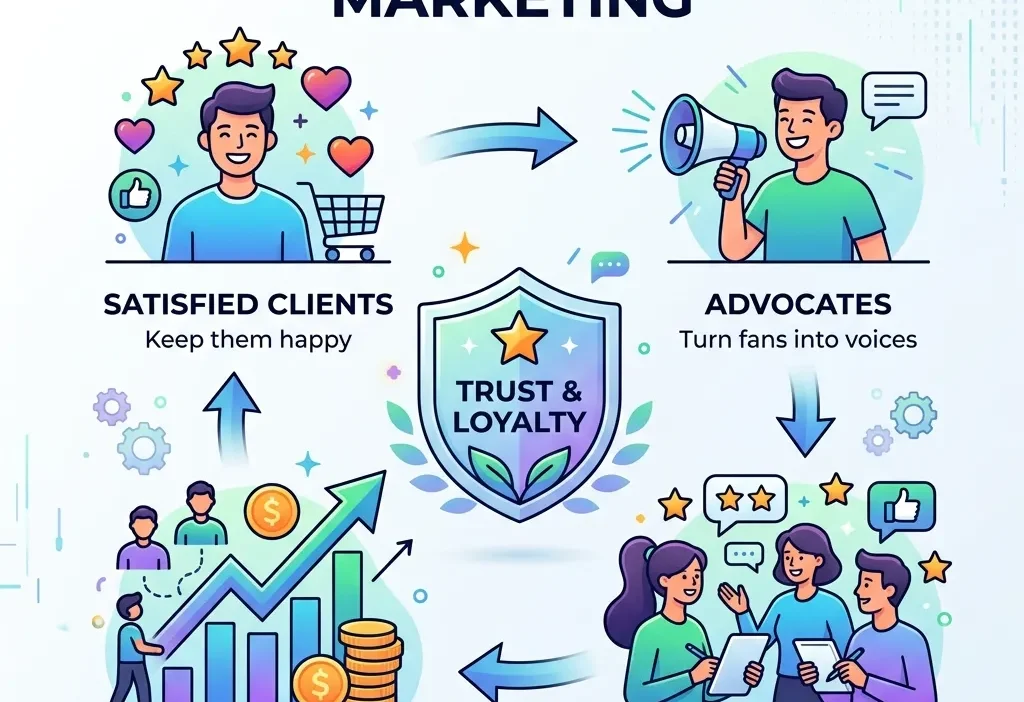
Customer advocacy usually begins with a positive customer experience. When customers consistently receive value from a product or service, some become willing to share that experience with others.
The process can be viewed as:
Customer Experience → Satisfaction → Engagement → Advocacy → Referrals and Social Proof
Businesses can support this process by identifying satisfied customers and providing meaningful opportunities for them to participate.
Customer Advocacy vs Traditional Marketing
Traditional marketing primarily communicates from the company to potential customers. Customer advocacy adds another voice: the customer.
For example, an advertisement may claim that a software product saves businesses time. A customer case study can demonstrate how a real company used the software to improve its workflow.
This makes advocacy particularly valuable for businesses that depend on trust, reputation, and long-term customer relationships.
Why Is Customer Advocacy Marketing Important?
Builds Customer Trust
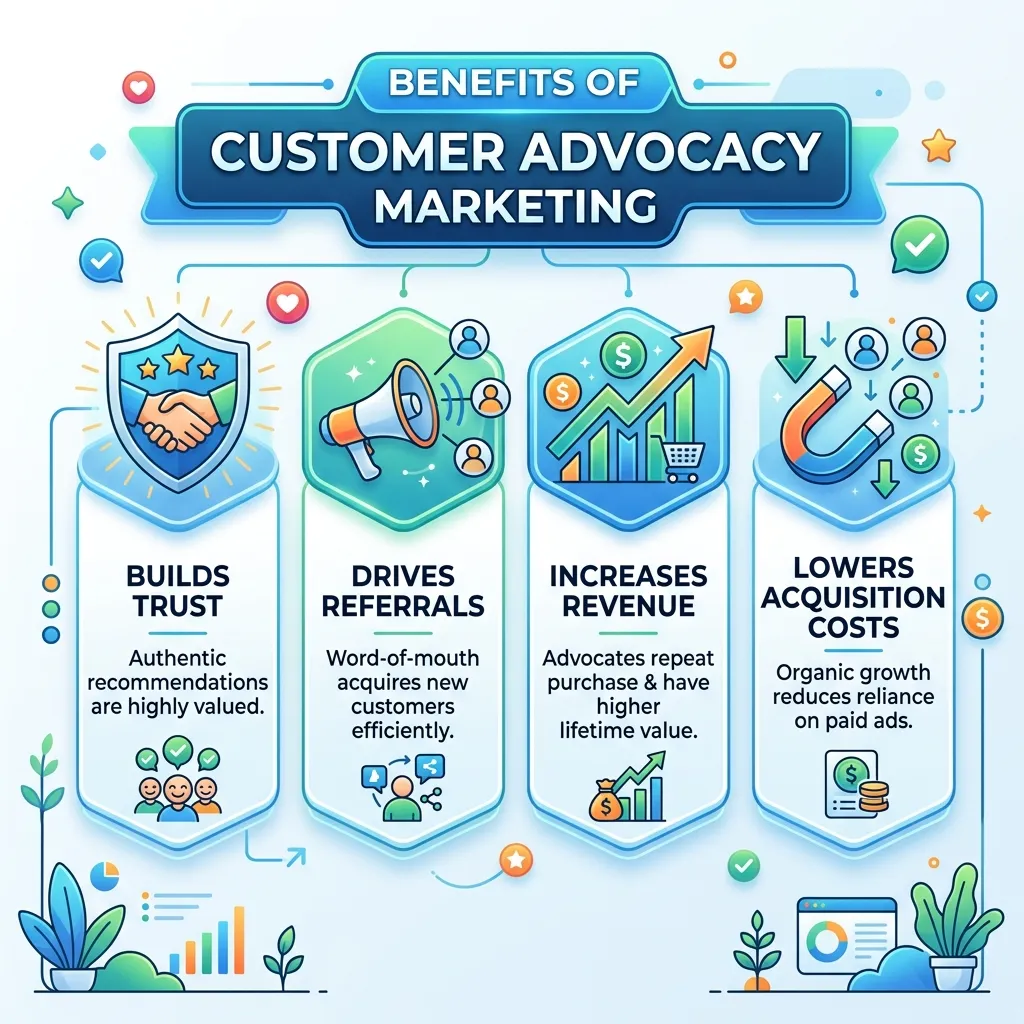
Customers may be more receptive to authentic experiences from other customers than purely promotional messages.
Reviews, testimonials, case studies, and referrals provide social proof that can help prospects evaluate a product.
Increases Social Proof
Social proof demonstrates that other people have already purchased, used, or benefited from a product or service.
Businesses can create social proof through:
- Customer reviews
- Ratings
- Testimonials
- Case studies
- Customer videos
- User-generated content
- Referral stories
Generates Referrals
Happy customers can introduce businesses to potential buyers through personal and professional networks.
Referral marketing can be particularly useful for service businesses, SaaS companies, agencies, professional services, and B2B organizations.
Improves Customer Retention
Customer advocacy is not only about acquiring new customers. Engaging loyal customers in communities, events, feedback programs, and exclusive experiences can strengthen their relationship with a business.
Creates Authentic Marketing Content
Customer stories can become valuable content assets for websites, email marketing, social media, sales presentations, webinars, and advertising campaigns.
Customer Advocacy Strategy
Identify Potential Customer Advocates
The first step in a customer advocacy strategy is identifying customers who are likely to participate.
Potential indicators include:
- High product engagement
- Repeat purchases
- Positive feedback
- Strong customer satisfaction
- Successful product implementation
- Referrals
- Community participation
- Frequent interaction with the company
Businesses can combine customer data with feedback and engagement signals to create an advocate shortlist.
Understand Advocate Motivations
Different customers participate for different reasons.
Some may value:
- Recognition
- Exclusive access
- Networking
- Educational opportunities
- Early product access
- Community membership
- Professional exposure
Understanding these motivations allows businesses to create more relevant advocacy opportunities.
Create Advocacy Opportunities
Give customers clear and simple ways to participate.
Examples include:
- Submit a testimonial
- Refer a colleague
- Join a customer community
- Participate in a case study
- Share a product experience
- Attend a customer event
- Provide product feedback
Reward and Recognize Advocates
Rewards can encourage participation, but they do not always have to be monetary.
Businesses can recognize advocates through:
- Badges
- Public recognition
- Exclusive content
- Early access
- Events
- Networking opportunities
- Loyalty benefits
The goal is to create mutual value rather than simply paying customers for positive promotion.
Measure Advocacy Performance
Track measurable outcomes such as referral conversions, advocacy participation, reviews, testimonials, engagement, retention, and revenue.
Customer Advocacy Program

What Is a Customer Advocacy Program?
A customer advocacy program is a structured initiative that identifies, engages, and recognizes customers who are willing to support a business.
A basic program can follow this model:
Identify → Invite → Engage → Recognize → Measure → Improve
For example, a SaaS company could invite highly engaged customers into an advocacy community. Members might participate in testimonials, referrals, product feedback sessions, webinars, and customer stories.
Key Elements of a Customer Advocacy Program
A strong program usually includes:
- Clear program objectives
- Advocate identification
- Customer segmentation
- Advocacy activities
- Communication channels
- Recognition or rewards
- Performance tracking
- Feedback collection
How to Structure an Advocacy Program
Start small instead of trying to create dozens of advocacy activities immediately.
For example:
Month 1: Identify potential advocates.
Month 2: Invite and onboard advocates.
Month 3: Launch testimonials and referral activities.
Month 4: Introduce case studies and community activities.
Month 5: Analyze results and optimize.
This approach gives the company time to understand what customers actually want.
Customer Advocacy Examples
Customer Testimonials
A customer provides a short statement describing their experience with a product or service.
Testimonials can be used on landing pages, product pages, emails, presentations, and social media.
Customer Case Studies
Case studies provide a deeper story by explaining:
- The customer’s original problem
- The solution they selected
- How the solution was implemented
- The results achieved
Referral Programs
Referral programs encourage existing customers to introduce new customers.
For example, a business might offer an existing customer a loyalty benefit when their referral becomes a customer.
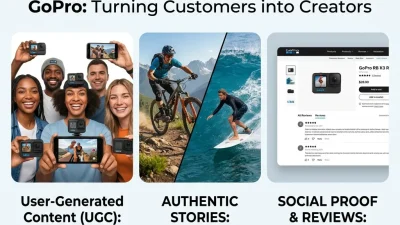
User-Generated Content
Customers can create:
- Videos
- Photos
- Social media posts
- Tutorials
- Product demonstrations
- Reviews
This content can provide authentic perspectives that complement branded content.
Customer Stories
Businesses can interview customers and publish their experiences as blog posts, videos, podcasts, or social media content.
Community Participation
Advocates can answer questions, share tips, and help other customers in online communities.
Customer Events
Businesses can invite advocates to participate in:
- Webinars
- Conferences
- Panels
- Podcasts
- Product launches
- Customer meetups
Who Are Customer Advocates?
Definition of Customer Advocates
Customer advocates are customers who actively support, recommend, or promote a company because they have had a positive experience with its product or service.
They may not see themselves as marketers. They simply believe the product provides enough value to recommend it.
Characteristics of Customer Advocates
Potential advocates often demonstrate:
- High satisfaction
- Strong engagement
- Product knowledge
- Loyalty
- Positive communication
- Willingness to provide feedback
- Willingness to recommend products
Types of Customer Advocates
Businesses may encounter several types of advocates:
Review Advocates: Customers who enjoy writing reviews.
Referral Advocates: Customers who frequently recommend products.
Content Advocates: Customers who create videos, posts, or other content.
Community Advocates: Customers who help other users.
Expert Advocates: Customers who are willing to speak at events or participate in case studies.
Customer Advocacy Campaigns

Review Campaigns
Businesses can ask customers for honest reviews after meaningful interactions or successful experiences.
The request should be transparent and should not pressure customers to provide a positive review.
Referral Campaigns
Referral campaigns encourage satisfied customers to introduce potential buyers.
A simple referral process should explain:
- Who can participate
- How referrals work
- What happens after a referral
- Any available benefits
Testimonial Campaigns
Businesses can invite customers to share specific experiences, such as how a product solved a problem or improved their workflow.
Customer Story Campaigns
Customer stories can turn individual experiences into engaging marketing assets.
Social Advocacy Campaigns
Companies can encourage customers to share genuine experiences on social media.
However, businesses should avoid scripted or misleading content. The U.S. Federal Trade Commission provides guidance on endorsements, reviews, and testimonials, including the importance of truthful and non-misleading endorsements. FTC: Endorsements, Influencers, and Reviews
Event Advocacy Campaigns
Invite advocates to participate in webinars, panels, conferences, podcasts, and other events.
Customer speakers can provide real-world perspectives that make educational events more credible and useful.
Customer Advocacy Platform
What Is a Customer Advocacy Platform?
A customer advocacy platform is software that helps businesses organize and manage customer advocacy activities.
Depending on the solution, a platform may help businesses:
- Identify advocates
- Manage advocacy campaigns
- Track participation
- Collect testimonials
- Organize referrals
- Manage rewards
- Measure performance
- Communicate with advocates
Features of Customer Advocacy Platforms
Important features may include:
- Advocate management
- Campaign management
- Rewards management
- Analytics
- Customer segmentation
- Referral tracking
- Content collection
- Community integration
Benefits of Using an Advocacy Platform
A platform can make large-scale advocacy programs easier to manage.
Instead of tracking every activity manually in spreadsheets, businesses can centralize campaigns, participants, activities, and performance data.
How to Choose a Customer Advocacy Platform
Consider:
- Program size
- Required integrations
- Analytics capabilities
- Automation
- Customer experience
- Scalability
- Pricing
- Security
- Ease of use
Technology should support the advocacy strategy rather than become the strategy itself.
Customer Advocacy vs Brand Advocacy
What Is Customer Advocacy?
Customer advocacy specifically focuses on customers recommending or supporting a business based on their customer experiences.
What Is Brand Advocacy?
Brand advocacy is broader. It can involve customers, employees, partners, creators, fans, and other people who support a brand.
Key Differences Between Customer and Brand Advocacy
| Customer Advocacy | Brand Advocacy |
|---|---|
| Focuses on customers | Includes a wider group of supporters |
| Based heavily on customer experience | Based on broader brand affinity |
| Includes reviews and referrals | Can include social promotion and brand awareness |
| Often connected to customer success | Can include employees and partners |
Therefore, customer advocacy can be viewed as one important part of a broader brand advocacy strategy.
How to Build Customer Advocacy
Step 1: Improve the Customer Experience
Advocacy begins with customer satisfaction.
Focus on:
- Product quality
- Customer support
- Onboarding
- Communication
- Reliability
- Problem resolution
Step 2: Identify Your Best Customers
Use customer engagement and satisfaction signals to find customers who may be interested in advocacy.
Step 3: Segment Your Advocates
Not every advocate should receive the same request.
One customer may be perfect for a case study, while another may be more comfortable making referrals.
Step 4: Create Simple Advocacy Actions
Start with easy activities such as:
- Writing a review
- Sharing feedback
- Referring a colleague
- Joining a community
- Sharing a customer story
Step 5: Provide Value to Advocates
Give advocates reasons to remain engaged.
Value can come through recognition, networking, education, exclusive access, or community participation.
Step 6: Build Long-Term Relationships
Do not communicate with advocates only when you need a testimonial.
Continue listening, sharing useful information, and involving them in relevant activities.
Step 7: Measure and Optimize Results
Review performance regularly and determine which activities produce the strongest results.
Customer Advocacy Best Practices
Start With Customer Experience
A company cannot build sustainable advocacy around a poor product or poor customer service.
Ask at the Right Time
The best moment to request advocacy is often after a positive customer milestone, successful implementation, repeat purchase, or meaningful interaction.
Make Participation Easy
Reduce friction with simple forms, clear instructions, and convenient communication.
Personalize Advocacy Requests
Instead of sending identical requests to everyone, match opportunities to individual customer interests.
Recognize Customer Advocates
Recognition helps customers feel that their contributions matter.
Avoid Fake or Manipulated Reviews
Businesses should never create fake reviews or manipulate customers into providing positive feedback.
The FTC’s guidance addresses deceptive review practices and emphasizes that reviews and testimonials should represent genuine experiences. FTC: Consumer Reviews and Testimonials Rule
Respect Honest Negative Feedback
A healthy advocacy strategy should not attempt to silence legitimate criticism.
The FTC notes that the Consumer Review Fairness Act protects consumers’ ability to share honest opinions about businesses and their products or services. FTC: Consumer Review Fairness Act
Measure Business Outcomes
Do not measure advocacy only by the number of participating customers.
Connect advocacy activities with:
- Leads
- Conversions
- Revenue
- Retention
- Customer lifetime value
Customer Advocacy Marketing Metrics
Advocate Participation Rate
Measures how many invited customers actually participate.
Referral Conversion Rate
Shows how many advocacy-generated referrals become customers.
Advocacy Engagement
Measures how actively customers participate in advocacy activities.
Review and Testimonial Volume
Tracks the number of reviews and testimonials generated.
Referral Revenue
Measures revenue generated through customer referrals.
Customer Retention
Helps determine whether advocacy engagement is associated with stronger customer relationships.
Advocate Lifetime Value
Measures the long-term business value generated by customers who actively advocate for a company.
Common Customer Advocacy Mistakes
Asking Every Customer to Do the Same Thing
Different customers have different interests, preferences, and levels of engagement.
Focusing Only on Rewards
Rewards can support advocacy, but they should not become the only reason customers participate.
Ignoring Negative Feedback
Negative feedback can reveal problems that need to be addressed.
Making Campaigns Too Complicated
Customers are less likely to participate when advocacy activities require too much time or effort.
Failing to Measure Results
Without measurement, businesses cannot determine which advocacy activities are creating meaningful outcomes.
Treating Advocacy as a One-Time Campaign
Customer advocacy should be treated as an ongoing relationship-building strategy rather than a single marketing campaign.
The Future of Customer Advocacy Marketing

Customer Communities
Communities can provide customers with places to share experiences, ask questions, and interact with one another.
User-Generated Content
Customer-created videos, reviews, images, and social posts will continue to provide valuable authentic content.
AI-Powered Personalization
AI can help businesses analyze customer engagement data and identify potential advocates or personalize advocacy requests.
Video Testimonials and Customer Stories
Video can make customer experiences more engaging by combining real people, stories, demonstrations, and outcomes.
The most effective future advocacy programs will likely combine technology with genuine human relationships.
Conclusion
Customer Advocacy Marketing gives businesses a way to turn positive customer experiences into trust, social proof, referrals, and authentic marketing content.
A successful strategy starts with delivering genuine customer value. Businesses can then identify potential customer advocates, create a structured customer advocacy program, develop relevant customer advocacy campaigns, and use a customer advocacy platform when scale requires it.
The most important principle is authenticity. Customers should never be pressured to provide misleading endorsements or positive reviews. Instead, businesses should create products, services, and experiences that customers genuinely want to recommend.
When customer advocacy becomes part of the broader customer experience strategy, it can support both customer acquisition and long-term relationships.
Frequently Asked Questions About Customer Advocacy Marketing
1. What is Customer Advocacy Marketing?
Customer Advocacy Marketing is a strategy that encourages satisfied customers to recommend, review, refer, or publicly support a business based on their genuine experiences.
2. What is a customer advocate?
A customer advocate is a customer who actively recommends or supports a company, product, or service because of a positive customer experience.
3. What is a customer advocacy program?
A customer advocacy program is a structured initiative that identifies and engages customers in activities such as referrals, testimonials, reviews, case studies, and events.
4. What are some customer advocacy examples?
Common examples include customer referrals, testimonials, reviews, case studies, user-generated content, customer stories, community participation, and event participation.
5. How do you identify customer advocates?
Businesses can identify potential advocates through customer satisfaction, engagement, repeat purchases, positive feedback, referrals, product usage, and community participation.
6. What is a customer advocacy campaign?
A customer advocacy campaign is a focused initiative designed to encourage customers to complete a specific advocacy activity, such as submitting a testimonial or referring another customer.
7. Do customer advocacy programs need rewards?
No. Rewards can help, but recognition, exclusive access, education, networking, community membership, and early product access can also motivate advocates.
8. What is a customer advocacy platform?
A customer advocacy platform is software that helps businesses manage advocates, campaigns, referrals, testimonials, rewards, engagement, and performance.
9. What is the difference between customer advocacy and brand advocacy?
Customer advocacy focuses specifically on customers and their experiences with a company. Brand advocacy is broader and can include customers, employees, partners, creators, and other supporters.
10. How can a small business build customer advocacy?
A small business can start by identifying satisfied customers, collecting honest reviews, creating a referral process, requesting testimonials, featuring customer stories, and recognizing loyal customers.
11. How do you measure Customer Advocacy Marketing?
Businesses can measure customer advocacy using participation rates, referrals, referral conversions, reviews, testimonials, engagement, retention, customer lifetime value, and advocacy-generated revenue.
12. Why is Customer Advocacy Marketing important?
Customer Advocacy Marketing can help businesses build trust, strengthen social proof, generate referrals, create authentic content, improve customer relationships, and support sustainable growth.