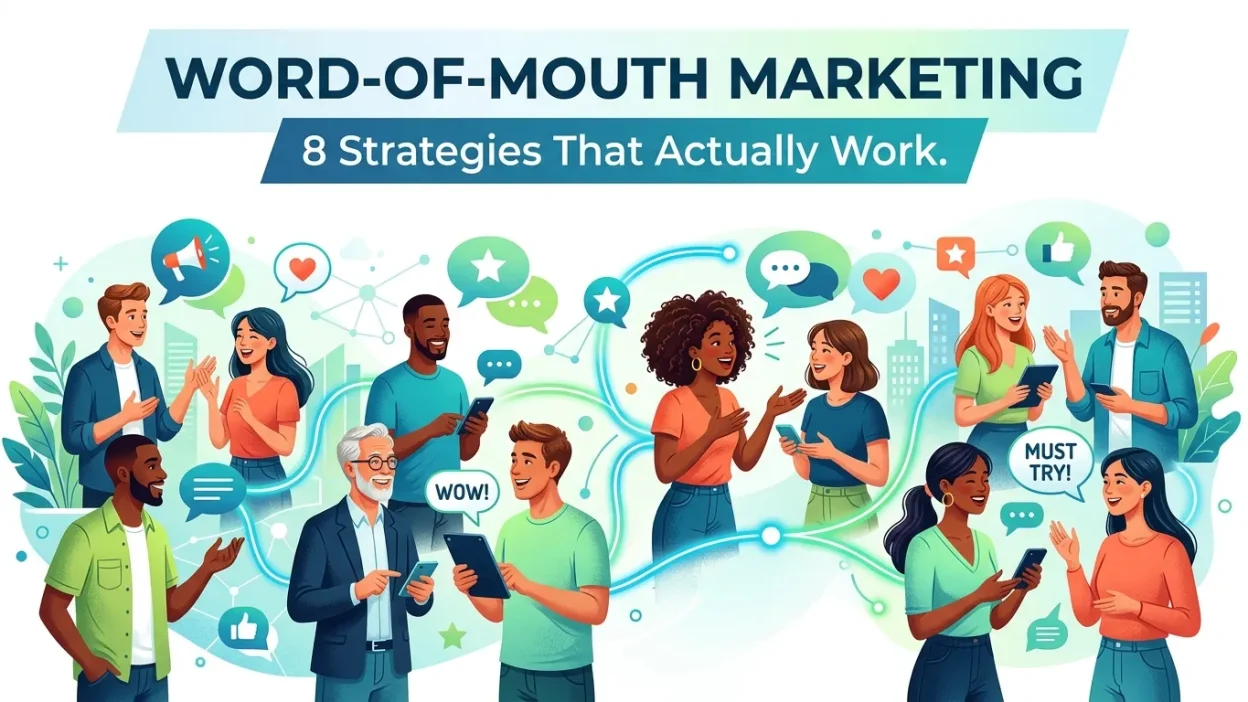
Word-of-mouth marketing (WOMM) helps businesses grow by encouraging customers to share positive experiences and recommendations. Effective WOM strategies such as referral programs, brand ambassadors, social proof, and customer advocacy can increase trust, attract new customers, and drive long-term business growth.
Word-of-mouth marketing (WOMM) is one of the most effective and cost-efficient growth strategies available to brands. This post covers eight proven WOM strategies—from referral programs and brand ambassador initiatives to social proof and viral campaigns—along with practical tips for implementing each one.
Every marketer knows the feeling: you’ve poured budget into paid ads, optimized your landing pages, and A/B tested your email subject lines—yet your most valuable customers keep coming from a friend’s recommendation. That’s word-of-mouth marketing at work, and it’s been outperforming traditional advertising for decades.
The numbers back this up. According to Nielsen, 92% of consumers trust recommendations from friends and family over any other form of advertising. Meanwhile, a study by Wharton School of Business found that referred customers have a 16% higher lifetime value than non-referred ones. Word-of-mouth marketing isn’t a nice-to-have—for many businesses, it’s the single most powerful acquisition channel available.
But here’s the thing: effective WOM marketing rarely happens by accident. The brands that benefit most from it have deliberately engineered conditions that make sharing feel natural, rewarding, and even fun. This guide breaks down eight proven word-of-mouth strategies you can start implementing today, from structured referral programs to viral campaign design and everything in between.
What Is Word-of-Mouth Marketing?
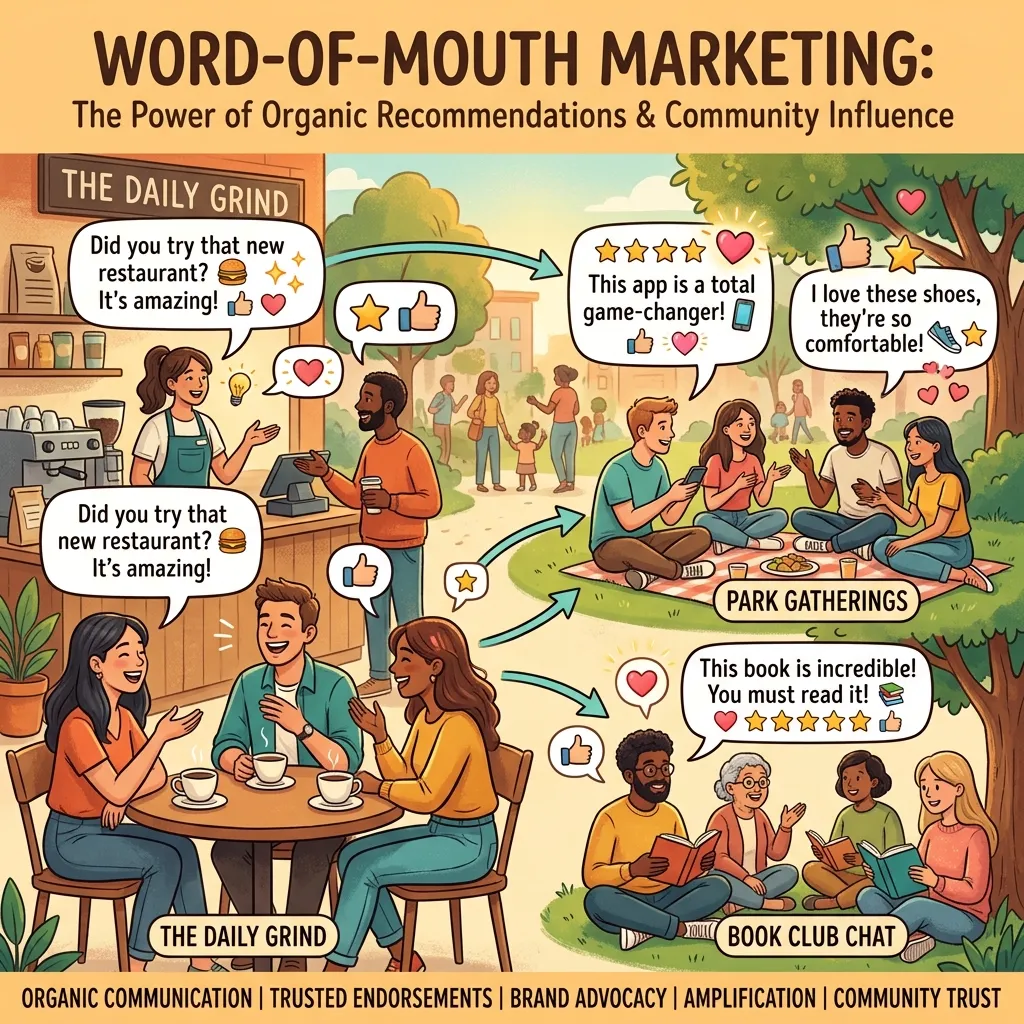
Word-of-mouth marketing (WOMM) is any business activity that encourages people to talk about your brand, product, or service—organically or through structured incentives. Unlike traditional advertising, WOMM relies on real people sharing real experiences, which makes it inherently more credible.
To better understand why recommendations influence purchasing decisions so strongly, explore the psychology of word-of-mouth marketing .
WOMM broadly falls into two categories:
- Organic WOM: Customers share their experiences naturally, without any prompting or incentive from the brand.
- Amplified WOM: Brands create campaigns, programs, or incentives specifically designed to encourage and scale word-of-mouth sharing.
The most successful brands combine both. They deliver a product experience worth talking about, then build systems that make it easy—and rewarding—for customers to spread the word.
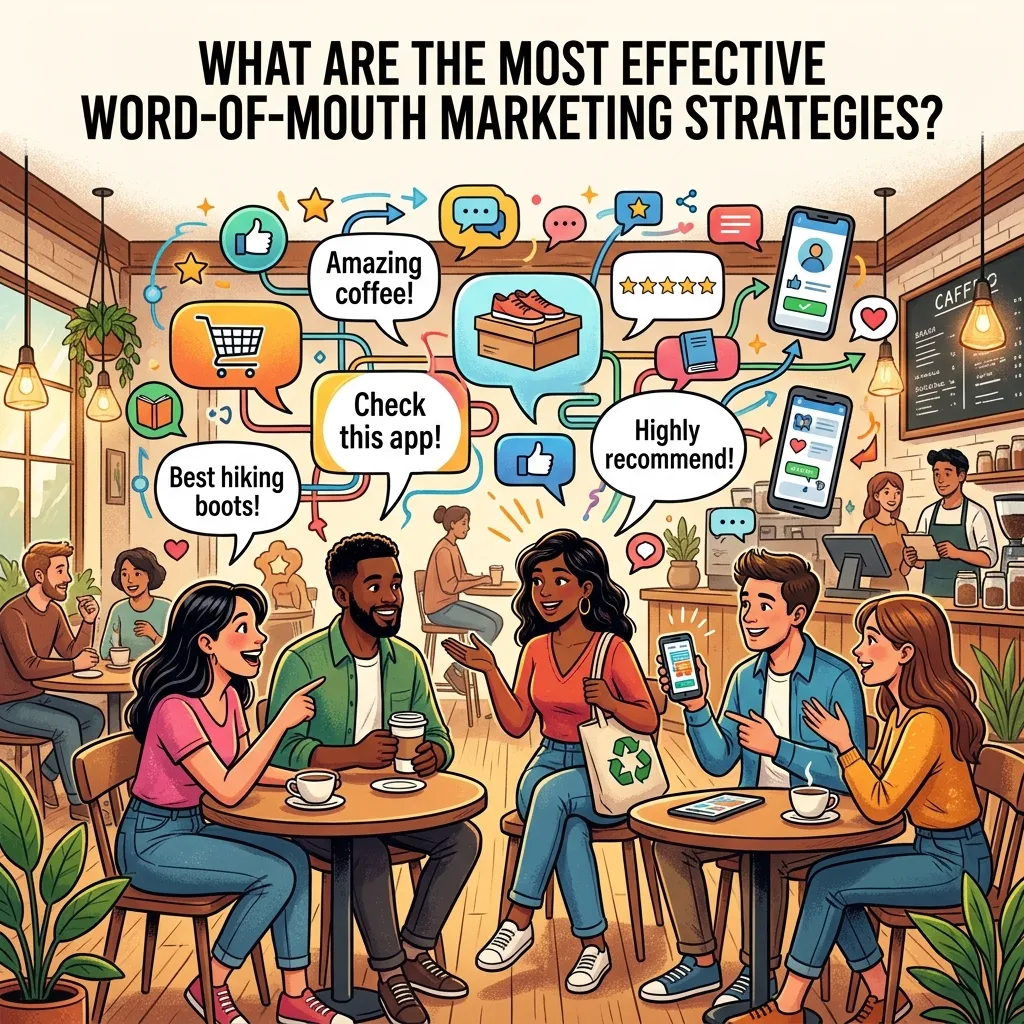
What Are the Most Effective Word-of-Mouth Marketing Strategies?
Referral Marketing Programs
Referral marketing is the most structured form of WOM, and for good reason—it works. A well-designed customer referral program gives existing customers a tangible reason to recommend your brand, typically through discounts, credits, or exclusive perks.
Dropbox is the textbook example. The company grew its user base by 3,900% in 15 months by offering extra storage space to both the referrer and the referred user. The key to their success? The incentive was directly tied to the product’s core value. Customers didn’t receive a generic discount—they got more of what they already loved.
When building a referral program, keep these principles in mind:
- Make the incentive relevant: Tie the reward to your product or service where possible.
- Keep the process simple: A referral flow with too many steps will kill conversion rates. The share action should take no more than 30 seconds.
- Reward both sides: Double-sided incentives (rewarding both the referrer and the new customer) consistently outperform one-sided ones.
Tools like ReferralCandy, Friendbuy, and Impact make it straightforward to build and track referral programs at scale.
Brand Ambassador Programs
Brand ambassador programs formalize relationships with your most loyal and vocal customers, turning them into ongoing advocates for your brand. Unlike one-off influencer deals, ambassadors typically have a long-term relationship with the brand and generate authentic, consistent promotion.
Before launching an ambassador initiative, it’s important to understand what brand advocates are and how they drive business growth.
The best ambassador programs identify customers who already love the product. When REI launched its ambassador program, the company focused on outdoor athletes and enthusiasts who genuinely used REI gear—not celebrities with no connection to the brand. The result: content that felt real, because it was.
To build an effective brand ambassador program:
- Define clear criteria: What does your ideal ambassador look like? Consider audience size, content quality, and genuine affinity for your brand.
- Create mutual value: Ambassadors should receive meaningful benefits—early product access, exclusive events, or financial compensation—not just free products.
- Give creative freedom: Over-scripted content reads as advertising. Trust your ambassadors to communicate your brand’s value in their own voice.
Customer Advocacy Marketing
Customer advocacy goes beyond referrals. Advocates don’t just refer friends—they actively defend, promote, and champion your brand in public spaces like social media, review platforms, and online communities.
Companies like Apple and Peloton have cultivated communities of fierce brand advocates who voluntarily promote the brand without any formal incentive. This kind of advocacy is fueled by emotional connection and exceptional product experience.
For a deeper dive into creating sustainable advocacy efforts, read our brand advocacy strategy guide.
To build genuine customer advocacy:
- Invest in customer success: Customers who achieve meaningful results with your product become natural advocates. Proactively helping them succeed—through onboarding, education, and support—pays dividends in advocacy.
- Recognize and celebrate advocates: Feature customer stories on your website, share user-generated content, and publicly thank advocates for their support.
- Create exclusive communities: Private communities (like Slack groups or branded forums) give advocates a space to connect with each other and your team, deepening their loyalty.
Social Proof Marketing
Social proof is the psychological principle that people look to others’ behavior when making decisions. In marketing, it encompasses reviews, ratings, testimonials, case studies, and user-generated content (UGC)—all of which signal to potential customers that your product is worth buying.
According to BrightLocal’s 2023 Local Consumer Review Survey, 98% of consumers read online reviews for local businesses, and 49% trust reviews as much as personal recommendations from friends. That figure has significant implications for how brands should prioritize review generation.
Practical social proof tactics include:
- Automated review requests: Send post-purchase emails requesting reviews on platforms like Google, Trustpilot, or G2. Timing matters—request reviews when customer satisfaction is likely highest (e.g., shortly after a successful delivery or product milestone).
- Display UGC prominently: Feature real customer photos and videos on product pages, social channels, and email campaigns. UGC converts because it shows the product in real-world use.
- Leverage case studies strategically: For B2B brands especially, detailed case studies that quantify outcomes (e.g., “reduced churn by 30%”) build trust with high-intent buyers.
Viral Marketing Campaigns
Viral marketing aims to create content so compelling that people feel compelled to share it—generating exponential reach from a relatively small initial push. While true virality can’t be manufactured on demand, certain content conditions make it far more likely.
Research by Jonah Berger, author of Contagious: Why Things Catch On, identifies six drivers of shareable content: social currency (sharing makes people look good), triggers (the content is top of mind), emotion, public visibility, practical value, and stories. The most viral content typically hits at least two or three of these drivers simultaneously.
Campaigns worth studying:
- Dollar Shave Club’s launch video (2012): A low-budget, irreverent video that racked up 12,000 orders within 48 hours of posting—because it was genuinely funny and offered obvious practical value.
- ALS Ice Bucket Challenge (2014): Raised over $115 million in eight weeks by combining public visibility, social currency, and emotional resonance.
When designing campaigns with viral potential, focus on triggering a strong emotional response—whether humor, surprise, inspiration, or even outrage—and make sharing as frictionless as possible.
Consumer Recommendation Strategies
Sometimes the most powerful WOM tactics are the simplest: asking satisfied customers to share their experience. Many businesses underestimate how often customers will recommend a product if they’re simply asked.
The Net Promoter Score (NPS) framework—developed by Bain & Company—identifies your “Promoters” (customers who score you 9 or 10 out of 10). These customers are statistically the most likely to recommend you, yet many brands never directly engage them about advocacy opportunities.
Recommendations compound when brands:
- Embed sharing prompts at peak satisfaction moments: Right after a customer completes a meaningful action (makes their first purchase, achieves a key outcome, or leaves a positive review), present a simple sharing prompt.
- Make sharing feel natural: “Know someone who might benefit from this?” performs better than “Share our product!” because it frames the recommendation as helpful rather than promotional.
- Follow up with referred customers quickly: Speed matters. A study by Harvard Business Review found that following up on leads within an hour makes conversion 7x more likely than following up even an hour later.
Organic Brand Promotion Through Content and Community
Not all WOM marketing requires a formal program or campaign. Organic brand promotion happens when a company’s content, community, or culture becomes inherently shareable.
Notion is a strong example. The productivity platform built a massive organic following by providing free templates, supporting a community of creators who build and share Notion setups, and fostering a genuine culture of creativity. Users share their Notion workspaces the same way people share playlists—because it reflects something personal and aspirational.
To build a foundation for organic promotion:
- Create content people want to share: Shareable content solves specific problems, surprises the reader, or makes them look knowledgeable for passing it on.
- Build a community around shared values: Brands with strong communities—not just audiences—generate far more organic conversation because members promote the community itself.
- Be consistently remarkable: The most reliable source of WOM is a product or experience that genuinely exceeds expectations. No program can compensate for mediocrity.
Customer-Driven Marketing Through Co-Creation
Customer-driven marketing invites customers to actively participate in product development, content creation, or campaign ideation. When customers feel genuine ownership over a brand’s direction, their advocacy becomes personal.
LEGO’s Ideas platform allows fans to submit product concepts; those that reach 10,000 votes are reviewed by LEGO’s design team for potential commercial release. The result is a self-sustaining marketing engine—fans who submit ideas share the platform widely to gather votes, generating enormous organic reach for LEGO while simultaneously validating product concepts.
Co-creation tactics to consider:
- Product feedback loops: Publicly acknowledge and act on customer feedback. When customers see their suggestions implemented, they become invested stakeholders.
- User-generated content campaigns: Create campaigns that invite customers to contribute content—photos, stories, reviews—and spotlight the best contributions.
- Beta programs: Give a curated group of customers early access to new features or products in exchange for honest feedback. Beta users frequently become vocal advocates.
Building a Word-of-Mouth Strategy That Scales

The brands that succeed with WOM marketing don’t rely on any single tactic. They build layered systems where referral programs, ambassador relationships, social proof, and organic community reinforce each other.
A practical starting point: identify your current Promoters using an NPS survey, then systematically engage them across multiple touchpoints—invite them into your ambassador program, feature their stories as social proof, and build a referral program that rewards them for doing what they’re already inclined to do.
Word-of-mouth marketing compounds over time. Every advocate acquired today generates referrals next month, and the month after that. The brands that invest in these systems early build a durable growth engine that paid advertising simply can’t replicate.
Frequently Asked Questions
What is the difference between word-of-mouth marketing and referral marketing?
Word-of-mouth marketing (WOMM) is the broader category—it includes any organic or structured activity that leads customers to recommend a brand. Referral marketing is a specific subset of WOMM that uses formal programs and incentives (such as discounts or credits) to encourage customers to refer others. Referral marketing is more measurable and scalable; organic WOM is harder to control but often more trusted.
How do you measure the success of a word-of-mouth marketing strategy?
Key metrics for WOM include Net Promoter Score (NPS), referral conversion rate, customer acquisition cost (CAC) for referred customers, lifetime value (LTV) of referred customers, share of voice on social media, and volume of organic reviews and UGC. Tools like Google Analytics, ReferralCandy, and brand monitoring platforms like Mention or Brandwatch can help track these metrics.
How can small businesses with limited budgets use word-of-mouth marketing?
Small businesses can focus on low-cost, high-impact tactics: providing exceptional customer service, proactively asking satisfied customers for reviews and referrals, featuring customer stories on social media, and building a community (even a simple Facebook Group or email newsletter) around shared interests. A simple double-sided referral incentive—even a modest discount—can drive meaningful results without large upfront investment.
Are brand ambassador programs only effective for large brands?
No. Many direct-to-consumer startups and small businesses run highly effective ambassador programs by identifying a small group of genuinely passionate customers. The key is selecting ambassadors based on authentic affinity for the product rather than audience size alone. A micro-ambassador with 2,000 engaged followers who genuinely loves your product will often outperform a celebrity with millions of passive followers.
How long does it take to see results from a word-of-mouth marketing strategy?
Results vary significantly by strategy. A well-designed referral program can generate measurable results within weeks. Building a brand ambassador community or cultivating organic advocacy typically takes three to six months to gain meaningful traction. Long-term WOMM investments—like community building and consistent customer experience improvements—compound over years and often deliver the highest ROI over time.
What are WOM strategies?
WOM strategies are marketing techniques designed to encourage customers to recommend, discuss, and promote a brand through word-of-mouth marketing.
Why are WOM strategies important for business growth?
WOM strategies help businesses build trust, lower customer acquisition costs, and generate highly qualified leads through personal recommendations.
What is the most effective word-of-mouth marketing strategy?
Referral marketing is often considered the most effective strategy because it provides incentives for customers to recommend products or services to others.
How do brand ambassador programs support WOM marketing?
Brand ambassadors promote products authentically, create user-generated content, and help increase brand visibility through trusted recommendations.
What role does social proof play in WOM strategies?
Social proof, including reviews, testimonials, and case studies, builds credibility and encourages potential customers to trust a brand.
How can small businesses implement WOM strategies?
Small businesses can focus on exceptional customer service, referral incentives, online reviews, customer stories, and community engagement to generate word-of-mouth.
What is customer advocacy marketing?
Customer advocacy marketing encourages loyal customers to actively promote and defend a brand through recommendations, reviews, and social media engagement.
Can viral marketing improve word-of-mouth marketing results?
Yes. Viral marketing campaigns can significantly increase brand exposure and encourage large-scale sharing when content is highly engaging and shareable.
How do you measure the success of WOM strategies?
Success can be measured through referral rates, Net Promoter Score (NPS), customer lifetime value, review volume, social mentions, and conversion rates from referrals.