

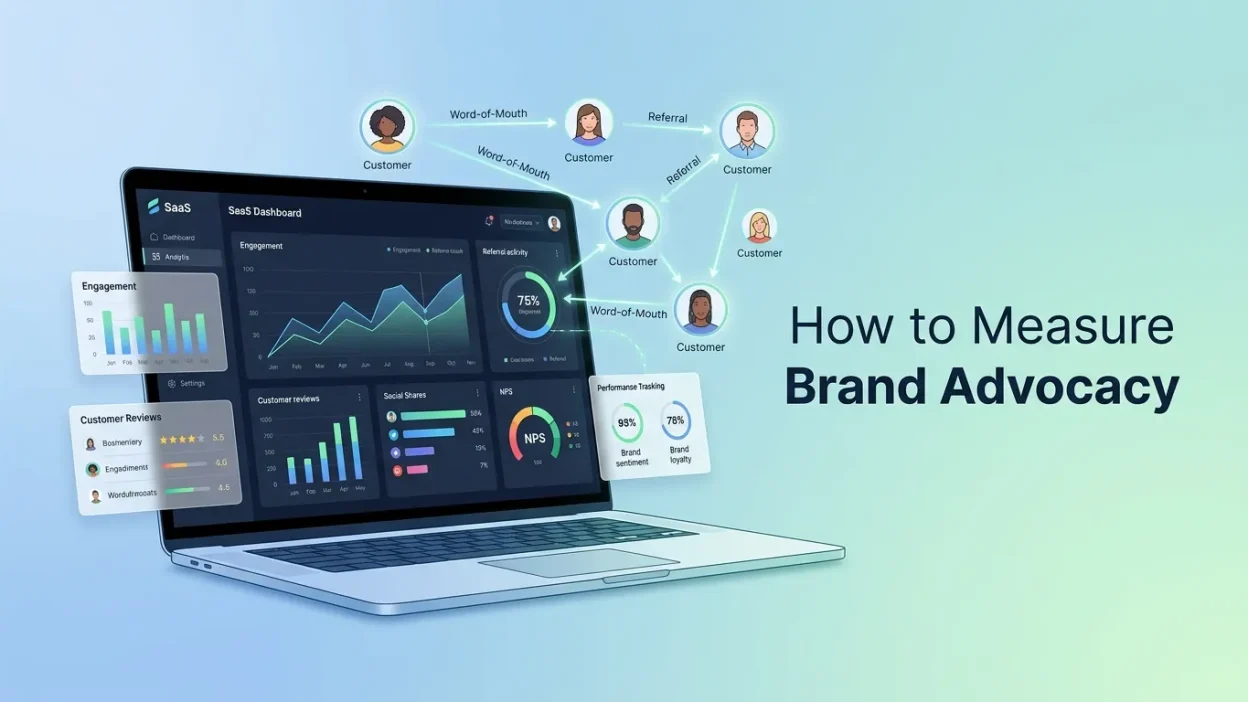
To measure brand advocacy, track a mix of quantitative and qualitative metrics—Net Promoter Score (NPS), referral rates, social media mentions, customer lifetime value, and brand sentiment. Combine these data points to understand how loyal customers promote your brand and to calculate the ROI of your advocacy efforts.
Happy customers are your best marketers. They recommend your products to friends, defend your brand online, and keep coming back without being asked. This is brand advocacy in action—and it’s one of the most valuable (yet hard to quantify) assets your business owns.
The problem? Many marketers know advocacy matters but struggle to put numbers behind it. Without clear measurement, you can’t tell whether your efforts are working, where to invest, or how advocacy affects your bottom line.
This guide breaks down the exact metrics, KPIs, and tools you need to measure brand advocacy with confidence. You’ll learn how to track everything from referrals and reviews to sentiment and ROI—so you can turn your most enthusiastic customers into a measurable growth engine.
What is brand advocacy (and why measure it)?

Brand advocacy happens when customers actively promote your brand through reviews, referrals, social media posts, and word-of-mouth recommendations. Unlike paid promotion, advocacy is voluntary and genuine, which makes it far more persuasive to potential buyers.
Measuring brand advocacy matters for three reasons. First, advocates lower your customer acquisition costs. Second, they tend to spend more and stay loyal longer. Third, tracking advocacy helps you understand which emotional triggers drive loyalty, often reinforced through social proof in word-of-mouth marketing.
Without measurement, advocacy stays a vague concept. With it, you gain a clear picture of which customers love you, why they love you, and how that love translates into revenue.
What are the key brand advocacy metrics and KPIs?
Effective measurement starts with choosing the right indicators. Brand advocacy performance indicators fall into two broad categories: numbers that show how much advocacy is happening, and signals that reveal how strong that advocacy feels.
Here are the core metrics worth tracking:
- Net Promoter Score (NPS): Measures how likely customers are to recommend you.
- Referral rate: The percentage of new customers who came from existing customer recommendations.
- Customer lifetime value (CLV): The total revenue a customer generates over their relationship with you.
- Social media mentions and shares: How often people talk about and amplify your brand online.
- Review volume and rating: The number and average score of customer reviews.
- Brand sentiment: The emotional tone behind what people say about you.
- Repeat purchase rate: How often customers buy from you again.
No single metric tells the whole story. The strongest advocacy programs blend several KPIs to balance hard numbers with emotional context.
How do you use Net Promoter Score (NPS) for brand advocacy?

Net Promoter Score is the most widely used metric for advocacy, and for good reason—it’s simple, fast, and directly tied to recommendation behavior.
NPS comes from a single question: “On a scale of 0 to 10, how likely are you to recommend us to a friend or colleague?” Based on their answers, customers fall into three groups:
- Promoters (9–10): Loyal enthusiasts who fuel growth through referrals.
- Passives (7–8): Satisfied but unenthusiastic customers who could be swayed by competitors.
- Detractors (0–6): Unhappy customers who may damage your reputation through negative word-of-mouth.
To calculate your score, subtract the percentage of detractors from the percentage of promoters. The result ranges from -100 to +100. A positive score is generally good, while a score above +50 is considered excellent.
NPS works best when you act on it. Follow up with promoters by inviting them into referral or ambassador programs. Reach out to detractors to fix problems before they spread. Track your score over time to see whether advocacy is trending up or down.
What are the best customer advocacy measurement strategies?
Measuring advocacy isn’t a one-time exercise. The most reliable approach combines several strategies that capture both behavior and emotion.
A key part of this process is building systems that consistently identify and activate promoters, similar to approaches in this guide on building a customer advocacy strategy.
Survey your customers regularly
Surveys—including NPS, customer satisfaction (CSAT), and customer effort score (CES)—give you direct insight into how customers feel. Run them at key moments, like after a purchase or support interaction, to capture timely, relevant feedback.
Track behavioral signals
Actions speak louder than survey responses. Monitor referrals, repeat purchases, upsells, and engagement with loyalty programs. These behaviors prove advocacy in a way that words alone can’t.
Listen across channels
Social media, review sites, forums, and community groups all reveal what customers say when you’re not asking. Social listening tools help you capture these unprompted mentions and gauge overall sentiment.
Segment your advocates
Not all advocates are equal. Some refer dozens of customers, while others simply leave a glowing review. Segmenting by advocacy level helps you focus resources on your highest-impact supporters.
How do you track social media brand advocacy?

Social media is where much of modern advocacy plays out. Customers tag your brand, share your content, and recommend you to their networks—all in public view.
Understanding engagement signals is easier when you connect them to real-world storytelling formats like those discussed in customer stories and testimonials strategies.
To track social media brand advocacy, focus on these metrics:
- Brand mentions: How often your brand name appears in posts and comments.
- Share of voice: Your brand’s mention volume compared to competitors.
- Engagement rate: Likes, comments, shares, and saves on your content.
- User-generated content (UGC): Posts customers create featuring your products.
- Hashtag performance: How often branded hashtags get used.
Tools like Sprout Social, Brandwatch, Hootsuite, and Mention automate this tracking. They let you monitor conversations, measure sentiment, and identify your most active advocates—the people who amplify your brand most often.
Pay special attention to user-generated content. When customers create posts about your products without being asked, it’s one of the clearest signals of genuine advocacy.
How do you analyze customer loyalty and advocacy?
Loyalty and advocacy are closely linked but not identical. A loyal customer keeps buying from you. An advocate goes further—they actively encourage others to buy too. Strong measurement connects the two.
To analyze customer loyalty and advocacy together, look at:
- Customer retention rate: The percentage of customers you keep over a given period.
- Churn rate: The percentage you lose.
- Repeat purchase rate: How frequently customers come back.
- Customer lifetime value (CLV): The long-term revenue each customer generates.
- Loyalty program participation: How many customers actively engage with rewards.
Cross-reference these loyalty metrics with advocacy signals like NPS and referrals. You’ll often find that your most loyal customers are also your most vocal advocates. Identifying this overlap helps you target the right people for ambassador programs and exclusive perks.
What tools measure word-of-mouth marketing?
Word-of-mouth is powerful but notoriously hard to track because so much of it happens in private conversations. Still, several tools help you capture and measure it.
- Referral software (like ReferralCandy, Mention Me, or Yotpo) tracks who refers whom and rewards customers for spreading the word.
- Review platforms (like Trustpilot, G2, and Google Reviews) capture public recommendations and ratings.
- Social listening tools (like Brandwatch and Talkwalker) monitor online mentions and conversations.
- Survey tools (like SurveyMonkey and Typeform) ask customers directly how they heard about you.
The “How did you hear about us?” survey question remains one of the simplest ways to surface word-of-mouth. Add it to your checkout or onboarding flow to capture referral sources you’d otherwise miss.
How do you track customer referrals?
Referrals are advocacy in its purest form—a customer putting their own reputation on the line to recommend you. Tracking referrals well gives you a direct line to your most valuable advocates.
Key customer referral tracking metrics include:
- Referral rate: The percentage of customers who refer at least one new person.
- Number of referrals per customer: How many new leads each advocate brings in.
- Referral conversion rate: The percentage of referred leads who become customers.
- Referral revenue: Total revenue generated from referred customers.
- Participation rate: The percentage of eligible customers who join your referral program.
Dedicated referral software makes this tracking automatic by assigning unique links or codes to each customer. This lets you attribute new business to specific advocates—and reward them accordingly.
How do you measure brand sentiment?
Brand sentiment reveals the feeling behind the conversation. You can have plenty of mentions, but if most are negative, that’s a warning sign rather than a win.
Sentiment analysis uses AI and natural language processing to classify mentions as positive, negative, or neutral. Tools like Brandwatch, Lexalytics, MonkeyLearn, and Talkwalker scan social posts, reviews, and comments at scale to give you an overall sentiment score.
To measure brand sentiment effectively:
- Track sentiment trends over time, not just snapshots.
- Compare sentiment before and after campaigns or product launches.
- Break sentiment down by channel, region, or customer segment.
- Watch for sudden shifts that signal a brewing PR issue or a viral win.
Positive sentiment paired with high mention volume is the sweet spot. It means people are talking about you and saying good things—the foundation of strong advocacy.
How do you measure advocacy marketing ROI?
Proving the return on advocacy efforts is what turns it from a “nice to have” into a budgeted priority. Measuring advocacy marketing ROI connects your programs to real financial outcomes.
To calculate advocacy ROI, follow these steps:
- Define the goal. Decide what you’re measuring—referral revenue, reduced acquisition costs, or higher retention.
- Track program costs. Add up the cost of referral rewards, ambassador perks, software, and staff time.
- Measure attributable revenue. Use referral codes, UTM links, and surveys to tie revenue back to advocacy.
- Apply the ROI formula. Subtract program costs from advocacy-driven revenue, divide by program costs, then multiply by 100.
For example, if your referral program generates $50,000 in revenue and costs $10,000 to run, your ROI is 400%.
Beyond direct revenue, factor in the savings from lower customer acquisition costs. Advocates bring in customers who trust them already, which often means higher conversion rates and longer retention than paid channels deliver.
Turning advocacy data into action
Measuring brand advocacy isn’t about collecting numbers for their own sake. It’s about understanding who champions your brand, why they do it, and how to encourage more of it.
Start small. Pick two or three metrics—NPS, referral rate, and brand sentiment make a solid foundation—and track them consistently. As you build confidence, layer in social listening, loyalty analysis, and ROI measurement for a fuller picture.
The brands that win at advocacy treat it as an ongoing relationship, not a campaign. Listen to your advocates, reward them, and act on what the data tells you. Do that, and your happiest customers will keep doing your best marketing for free.
Frequently asked questions
What is the single best metric for measuring brand advocacy?
There’s no perfect single metric, but Net Promoter Score (NPS) is the most popular starting point. It’s simple to run and directly measures how likely customers are to recommend you. For a fuller picture, pair NPS with referral rate and brand sentiment.
How often should I measure brand advocacy?
Measure continuously where possible. Track social mentions and sentiment in real time using listening tools, run NPS surveys quarterly, and review referral and loyalty metrics monthly. Consistent tracking reveals trends that one-off measurements miss.
What’s the difference between brand advocacy and customer loyalty?
Loyalty means a customer keeps buying from you. Advocacy goes a step further—the customer actively recommends you to others. All advocates are loyal, but not all loyal customers become vocal advocates. Strong measurement tracks both.
How do I measure the ROI of brand advocacy?
Track the revenue generated by advocacy programs (using referral codes and attribution links), subtract your program costs, divide by those costs, and multiply by 100. Don’t forget to factor in savings from lower customer acquisition costs.
Which tools are best for tracking brand advocacy?
The right tools depend on your goal. Use referral software (like Mention Me or Yotpo) for tracking referrals, social listening tools (like Brandwatch or Sprout Social) for mentions and sentiment, and survey platforms (like SurveyMonkey) for NPS and direct feedback.
What is the best way to start learning how to measure brand advocacy?
The best way to start how to measure brand advocacy is by tracking basic metrics like NPS, referral rates, and customer sentiment across different channels.
Why is it important to understand how to measure brand advocacy?
Understanding how to measure brand advocacy helps businesses identify loyal customers who actively promote their brand and drive organic growth.
What metrics are used in how to measure brand advocacy?
Key metrics for how to measure brand advocacy include Net Promoter Score (NPS), referral traffic, customer lifetime value, and social media mentions.
Can NPS help in how to measure brand advocacy effectively?
Yes, Net Promoter Score is a core tool in how to measure brand advocacy because it shows how likely customers are to recommend your brand.
How does social media help in how to measure brand advocacy?
Social media plays a big role in how to measure brand advocacy by tracking mentions, shares, comments, and user-generated content.
What tools are useful for how to measure brand advocacy?
Tools like Brandwatch, Sprout Social, and Google Analytics support how to measure brand advocacy by tracking sentiment and customer behavior.
How do referrals impact how to measure brand advocacy?
Referral data is essential in how to measure brand advocacy because it directly shows how often customers recommend your brand to others.
How often should businesses focus on how to measure brand advocacy?
Businesses should regularly focus on how to measure brand advocacy monthly or quarterly to track changes in customer loyalty and engagement.
What role does customer sentiment play in how to measure brand advocacy?
Customer sentiment is crucial in how to measure brand advocacy because it reflects how people feel about your brand beyond numbers.
How does ROI relate to how to measure brand advocacy?
ROI is an important part of how to measure brand advocacy as it shows the financial impact of loyal customers and referral-driven growth.



[…] For additional measurement ideas, see How to Measure Brand Advocacy: Metrics, KPIs & Tools. […]
[…] retention, and revenue rather than just tracking participation for its own sake. Our guide on measuring brand advocacy metrics and KPIs covers the specific metrics a strong platform should make easy to […]